
| Ahead of the second political trilogue on the Single Currency Package on 10 September 2026, the Council Presidency has asked Member States whether the exceptions to mandatory cash acceptance in Article 5 of the legal tender regulation should be expanded, and in which circumstances. Five categories are on the table — sector-specific carve-outs, business-to-business transactions, recurring payments, security-related situations and anti-money-laundering considerations — together with a wider national discretion to restrict acceptance on public-interest grounds. A joint statement by ten merchant and business associations adds a sixth: a self-assessed exemption for “objective and demonstrable” health, safety or security risks, including defined time windows. This note assesses the economic impact of that expansion using the most recent ECB, Eurostat and industry data. Its central finding is that the scope of these exceptions, as currently framed, is far wider than the narrow set of cases used to justify them, and that the cost they impose — through exclusion, infrastructure economics and resilience — is large, cumulative and falls disproportionately on the groups the regulation is designed to protect. |
1. What is being proposed, and by whom
The Presidency discussion note of 31 August 2026 (WK 13232/2026) lists the circumstances raised by Member States as candidates for additional exceptions, and asks two questions for the working party of 4 September: whether Member States agree in principle to expanding Article 5, and which circumstances should be targeted. The merchant statement of August 2026 proposes a specific amendment, Article 5(1)(d), exempting acceptance wherever it “would lead to objective and demonstrable health, safety and/or security risks”, with Member States defining “time windows and high-risk contexts”. The two documents overlap substantially. Table 1 sets them side by side.
| Proposed exception | Source | Cash volume currently at stake | Who bears the cost if adopted |
| Sectors where cash is not typically accepted today (insurance, landlords, airlines) | Presidency note, Member States | Low by volume; airlines already do not accept cash at booking. Rent paid in cash exists but is unmeasured at EU level. | Tenants and policyholders without accounts or with low digital skills; the precedent of carving out by sector rather than by objective criterion. |
| Business-to-business transactions | Presidency note, Member States | Low. ECB company survey: 22% of companies withdraw cash, 82% of those only to hold change. | Small traders and sole proprietors paying suppliers in cash; already capped at €10,000 by the AMLR from July 2027. |
| Recurring payments (telecoms, utilities, subscriptions, insurance) | Presidency note, Member States | Low by volume; direct debit dominates. But recurring payments are essential services. | Households without bank accounts or with low digital skills, who settle bills over the counter in cash. |
| Security risk to merchants and staff (e.g. public transport, night hours) | Presidency note; merchant statement Art. 5(1)(d) | Potentially very large: a night-hours window of 22:00–06:00 removes one third of the day (ECB Opinion CON/2026/3 on the Dutch draft law). | Shift workers, travellers, anyone paying at night; and — because the risk is self-assessed — potentially anyone, anywhere the merchant declares a risk. |
| AML/CFT considerations | Presidency note, Member States | Already regulated: Regulation (EU) 2024/1624 bans cash payments of €10,000 or more from 10 July 2027 and allows lower national limits. | Duplicative; risk of AML being used as a general-purpose ground for refusal below the legal threshold. |
| Wider national discretion to restrict acceptance for reasons of public interest | Presidency note, several Member States | Unbounded by definition. | Everyone; converts a rule with listed exceptions into a default subject to open-ended national derogation. Hessischer Rundfunk already permits proportionate public-interest restrictions. |
Table 1. Sources: Council Presidency discussion note WK 13232/2026 (31 August 2026); Joint statement from European merchants (August 2026); ECB, Use of cash by companies in the euro area 2026; ECB Opinion CON/2026/3; Regulation (EU) 2024/1624.
It is worth noting, without implying any impropriety on the part of the signatories, that several of the sectors requesting exceptions have a direct commercial stake in the growth of electronic payments alongside their stated safety concerns. Airline ancillary revenue is increasingly built on co-branded credit-card partnerships with the same card networks the EU’s own sovereignty debate is trying to counterbalance; parking operators have moved much of their collection to app- and card-based fintech providers; and recurring-billing sectors such as insurance, telecoms and utilities save materially on collection costs when payment is by card or direct debit rather than cash. None of this determines whether the safety concerns raised are genuine — several plainly are — but it is a relevant fact for co-legislators to weigh when assessing how far to extend a self-assessed, sector-defined exception, rather than a narrower one anchored in the regulation’s own criteria.
2. The starting point: acceptance is high, stable and wanted
Any assessment of exceptions has to begin from the current state of acceptance, because the question is not whether cash acceptance should exist but how much of it a new set of carve-outs would remove. On that point the most recent evidence is unambiguous.
The ECB’s 2026 survey of 8,205 companies found that 92% of firms selling from physical premises accept cash, up from 90% in 2024, and that 92% of those plan to keep doing so for the next five years. The merchants’ own joint statement opens with the sentence “Merchants are happy to accept consumers paying with cash”. On the consumer side, SPACE 2024 recorded cash in 52% of point-of-sale transactions by number and 39% by value, and 62% of euro area consumers say it is important to have cash as a payment option — a share that rose between 2022 and 2024. A BEUC survey found that 85% of consumers believe cash should be accepted everywhere at no additional cost.
Against that background, the population of merchants for whom an exception would change behaviour is the 8% that do not accept cash today, plus whatever share of the 92% would use a new exemption to stop. The ECB survey allows a first-order decomposition of the 8%. Among non-accepting firms, 36% cite insufficient customer demand, 35% cite the inconvenience or difficulty of depositing and withdrawing cash — up from 22% in 2024 — and 29% cite security risk. Applied to the 8% base, that means roughly 2–3% of all euro area companies stop accepting cash for each of these reasons. Security, the ground on which the broadest new exception is being sought, is the least frequently cited of the three.
| Order-of-magnitude derivation. Non-accepting companies ≈ 8% of the total (ECB 2026). Of these, 29% cite security risk. 0.08 × 0.29 ≈ 2.3% of all companies. The corresponding figures for demand (36%) and infrastructure (35%) are ≈ 2.9% and ≈ 2.8%. Firms could give up to three reasons, so the shares overlap; the point is the scale, not the decimal. |
Two conclusions follow, and neither should be read as suggesting that cash refusal is a minor problem — the point is the opposite. First, the exception now being sought on security grounds is drawn far more broadly, and defined far more loosely (a self-assessed, open-ended “objective and demonstrable risk”, with time windows set at Member State discretion), than the narrow set of cases the merchants’ own reporting identifies. A remedy of that breadth, attached to a problem of that size, is where the proportionality question in Section 6 begins. Second, the fastest-growing reason for non-acceptance is not risk or demand but infrastructure — the difficulty of banking cash — which no exception addresses and which every exception worsens, for reasons set out in Section 4. That the underlying friction is currently limited is precisely why it should be handled through the existing enforcement and access provisions, not through a new general carve-out whose scope is set by the merchant rather than the regulation.
3. Channel one: exclusion — who pays when acceptance narrows
The Parliament’s mandate lists the groups whose access to cash Article 8 should particularly protect: older persons, persons with disabilities, people with low income or low digital skills, and unbanked persons. The Presidency now asks whether to keep that list, and whether to refer to “vulnerable groups” or “vulnerable consumers”. The economic point is that these groups are large, that they overlap, and that they are precisely the population for whom a merchant exception is not an inconvenience but a denial of service.
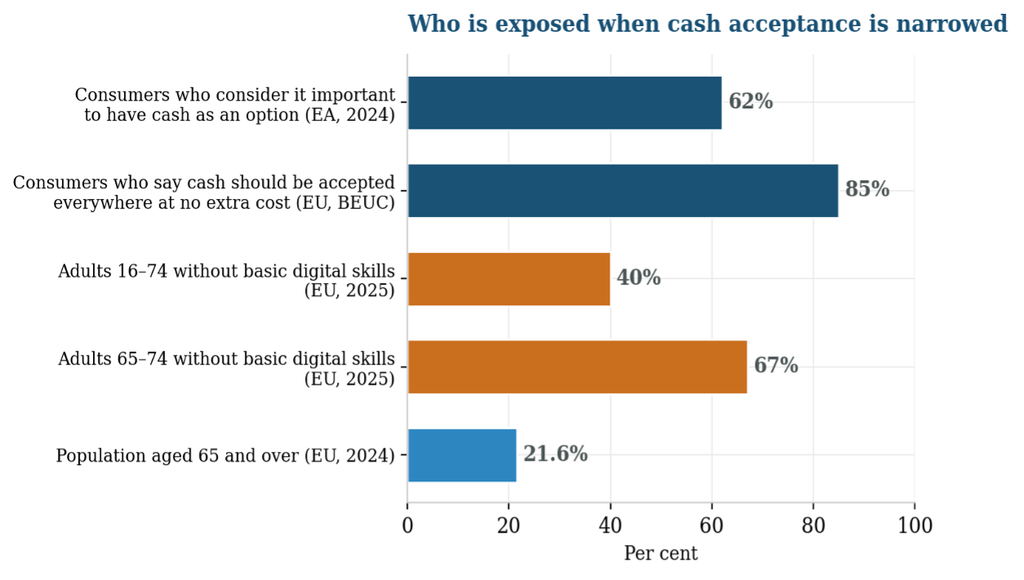
Chart 1. Sources: ECB SPACE 2024; BEUC (2026); Eurostat, Digital Skills Indicator 2025 (isoc_sk_dskl_i21); Eurostat demo_pjanind (2024).
Older people are 21.6% of the EU population (Eurostat, 2024) and about 22% of the euro area; on a euro area population of some 350 million, that is roughly 77 million people. Digital skills are the decisive variable for whether a person can substitute a card or an app for cash when a merchant refuses it: in 2025, 40% of EU adults aged 16–74 lacked at least basic digital skills, and among those aged 65–74 the share was 67% (Eurostat). The two groups overlap heavily, which is why the age gradient and the digital-skills gradient reinforce rather than merely add to each other.
The exposure is geographic as well as demographic. Denaria Europe’s Cash Observatory estimated in July 2026, using OpenStreetMap access-point data and the Eurostat 1 km² population grid, that at most around 24 million people in the euro area — some 7% — live more than 5 km from a cash access point, and at most about 5 million beyond 10 km. Both figures are upper bounds, and the method was validated against De Nederlandsche Bank’s 5 km coverage standard. For these residents, an exception that lets a local merchant refuse cash does not push them towards a card; it pushes them towards a longer journey to a merchant who still accepts it, or towards forgoing the purchase.
Each of the proposed exceptions lands on this population differently. A recurring-payments exception affects the unbanked and the digitally excluded who pay utility bills over the counter — the same households for whom a direct debit is not an option. A night-hours or transport exception affects shift workers and travellers. A sector carve-out for landlords affects cash-paying tenants at the bottom of the income distribution. None of the exceptions removes much aggregate volume from the cash cycle; each of them removes it from the people with the fewest alternatives.
4. Channel two: infrastructure — why exceptions cost more than their own volume
The second channel is the one most often missed in the trilogue debate, because it operates on the supply side of the cash cycle rather than at the point of sale. Cash infrastructure — ATMs, bank counters, cash-in machines, cash-in-transit routes — has high fixed costs and low marginal costs. When transaction volume falls, the cost per transaction rises for every remaining user, and the least profitable access points are withdrawn first: those in thin markets, rural areas and low-income neighbourhoods.
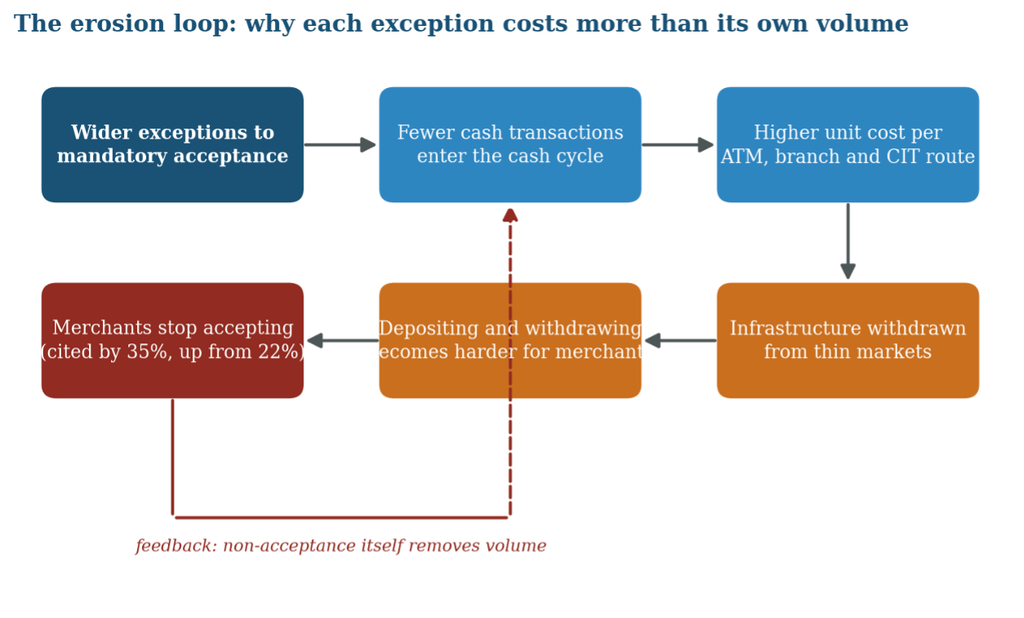
Figure 1. Mechanism illustrated from ECB (2026) company survey data on reasons for non-acceptance.
The infrastructure trend is already well advanced. Domestic bank branches in the EU-27 fell from 237,723 in 2008 to 129,418 in 2023, a decline of 45.5%. The euro area ATM stock stood at 253,700 at end-2024, down 3.1% in a year. Consumer-reported difficulty in accessing cash rose from 10% to 13% between 2022 and 2024 across the euro area, reaching 22–23% in Belgium. And on the merchant side, the ECB’s 2026 survey shows companies consolidating their cash logistics onto bank counters — now the leading channel for both deposits (58%) and withdrawals (60%) — at the same moment that the branch network hosting those counters keeps contracting.
This is the context in which the 22% → 35% jump in deposit-and-withdrawal difficulty as a reason for non-acceptance should be read. It is an early-warning indicator that infrastructure erosion has begun to feed back into acceptance. Every exception that removes cash volume from the cycle accelerates that feedback: fewer transactions, higher unit costs, more withdrawn access points, harder banking for merchants, more non-acceptance. The loop is self-reinforcing, and it is the reason the cost of an exception is not bounded by the volume it directly exempts.
The point can be stated in the language of the merchants’ own statement. They ask for an exemption where cash handling “poses a disproportionate risk to staff”. The disproportion the infrastructure channel identifies runs the other way: a small reduction in acceptance, concentrated in specific sectors or hours, imposes a cost on the entire cash cycle that is shared by every remaining user — including the 92% of merchants who want to keep accepting cash and would find it progressively more expensive to do so.
5. Channel three: resilience — the cost that appears only when everything else fails
The third channel is the one the ECB’s 2026 company survey identifies most clearly in merchants’ own judgement: firms rate cash ahead of digital payments on reliability, and there is no dimension in which they rate digital payments clearly better. Reliability is not an abstraction. On 28 April 2025 the entire Iberian Peninsula lost electrical power for around ten hours, and payment terminals, most ATMs and online commerce stopped with it.
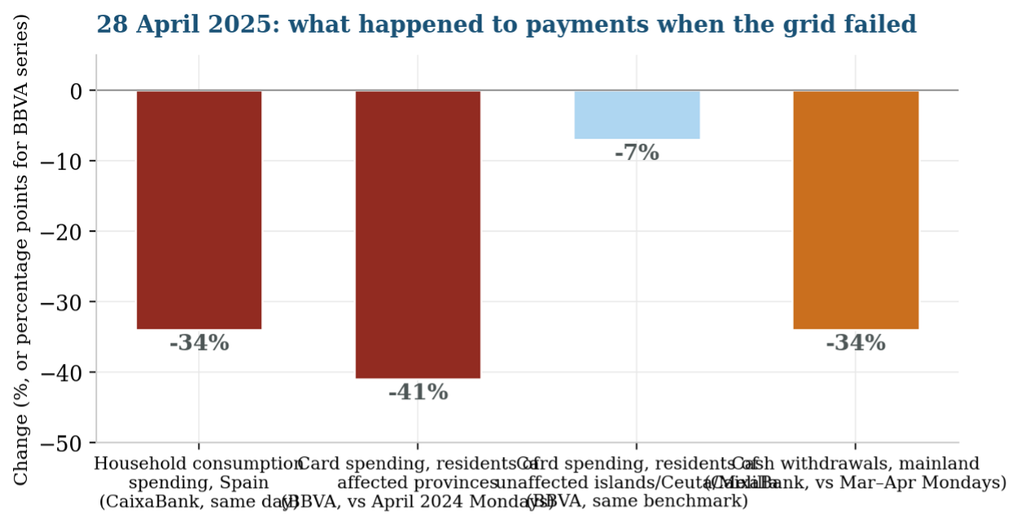
Chart 2. Sources: CaixaBank Research, ‘The economic impact of the blackout in detail’ (June 2025); BBVA Research, ‘The blackout in real time’ (May 2025).
CaixaBank Research, using its own card and ATM data, estimated that household consumption spending in Spain fell 34% on the day of the blackout; even after the rebound in subsequent days the net loss was about 15%, and the bank put the one-off impact on quarterly GDP at under €400 million. BBVA Research found that card spending by residents of the affected provinces was 41 percentage points below the April 2024 benchmark, against a fall of only 7 points among residents of the unaffected islands and enclaves — a clean natural experiment on what happens to a digital-only payment system when the grid fails. Cash withdrawals on the mainland also fell 34%, because most ATMs were down; outside the mainland they rose, for precautionary reasons.
The lesson for the exceptions debate is direct. Cash functioned during the blackout precisely in the places where it was still accepted and still in people’s pockets. A merchant who has used a security or time-window exemption to go cashless has, in the language of the Parliament’s own Article 8 provisions on cash resilience plans, removed the fallback that those plans are meant to guarantee. An exception granted for a normal Tuesday at 23:00 is also an exception in force at 23:00 on the night the grid fails. Resilience is a public good; it cannot be provided by a merchant-by-merchant opt-out.
6. From rule to default: the precedent problem
Beyond the three channels, there is a structural cost that is harder to quantify but easy to observe: each exception changes what the regulation is. The Commission’s proposal and the Council’s mandate establish mandatory acceptance as the rule with a short, closed list of exceptions. An open-ended public-interest discretion for Member States, or a self-assessed risk exemption for merchants, converts that architecture into a default that can be departed from wherever a plausible reason is asserted.
The Netherlands provides the test case. The Dutch mandatory acceptance law of June 2025 came with a set of exceptions, including one for payments between 22:00 and 06:00. The ECB’s Opinion CON/2026/3 of 22 January 2026 observed that such a window would deny legal tender status to euro cash for one third of the day, and that the combination of exceptions in the Dutch framework could lead “in law or in fact” to the elimination of cash from whole sectors: unattended premises, public transport, night hours, periodic payments, small enterprises. That list is, item for item, the list now on the trilogue table. The ECB also recalled the Court of Justice’s ruling in Hessischer Rundfunk (C-422/19 and C-423/19): restrictions on cash acceptance are permissible only where justified by a public-interest objective and proportionate to it. The national discretion Member States are now requesting already exists under that ruling; writing it into the regulation as a general clause would not add a power, it would remove the proportionality test.
The AML exception raises a parallel point. Regulation (EU) 2024/1624 already bans cash payments of €10,000 or more from 10 July 2027 and permits lower national thresholds — Belgium and the Netherlands are at €3,000, France, Spain and Italy at or below €1,000. A separate AML ground for refusing cash in the legal tender regulation would either duplicate that framework or, more likely, be invoked below its thresholds. The legislation that restricts cash on financial-crime grounds exists; what the legal tender regulation adds is the counterweight.
7. “Vulnerable groups” or “vulnerable consumers”
The Presidency’s third round of questions asks whether Article 8(1) should refer to “vulnerable groups” or “vulnerable consumers”, noting that some Member States query whether every group in the Parliament’s list is necessarily vulnerable, and citing the OECD’s situational definition of consumer vulnerability. The distinction is not merely terminological. A situational definition — vulnerability as a circumstance a person can move in and out of — is well suited to consumer-protection law generally. For cash access it has a specific drawback: the groups the Parliament lists are not vulnerable because of a passing circumstance but because of stable characteristics that determine whether they can substitute away from cash at all. A 70-year-old without basic digital skills, of whom there are two in every three in that age bracket, does not move out of that condition when a merchant declares a security window.
The data in Section 3 are the case for retaining an explicit reference to the listed groups. Whether the regulation calls them groups or consumers matters less than whether the monitoring indicators under Article 7 are required to measure their access specifically — a point BEUC’s trilogue position makes by calling for binding rather than voluntary indicators.
8. Summary of the evidence
| Question | What the evidence shows | Source |
| How much acceptance would new exceptions affect? | 92% of firms accept cash and 92% of those intend to continue. Security-driven non-acceptance ≈ 2.3% of all firms. | ECB company survey 2026 |
| Who is exposed? | ≈ 22% of the population aged 65+; 40% of adults lack basic digital skills (67% of 65–74s); at most ≈ 24 m beyond 5 km of an access point. | Eurostat; Denaria Observatory |
| Does volume loss stay contained? | No. Deposit/withdrawal difficulty as a reason for non-acceptance rose from 22% to 35% in two years; branches down 45.5% since 2008. | ECB 2026; EBF |
| What is the resilience cost? | Consumption −34% on the day of the Iberian blackout; card spending −41 pp in affected areas vs −7 pp elsewhere. | CaixaBank, BBVA Research |
| Is the AML exception needed? | No. The AMLR already bans cash ≥ €10,000 from July 2027 and allows lower national limits. | Reg. (EU) 2024/1624 |
| Is the public-interest discretion needed? | No. Hessischer Rundfunk already permits proportionate public-interest restrictions; a general clause removes the proportionality test. | CJEU C-422/19, C-423/19; ECB CON/2026/3 |
| What did a time-window exception look like in practice? | The Dutch 22:00–06:00 exception removes legal tender for one third of the day; the ECB warned the combined exceptions could eliminate cash from whole sectors. | ECB CON/2026/3 |
Taken together, the evidence points to an asymmetry, not to a case for indifference. The transaction volume the currently proposed exceptions would formally exempt is narrow relative to the scope co-legislators are being asked to write into the regulation. The costs run through three channels — exclusion of large and identifiable population groups, self-reinforcing erosion of cash infrastructure, and the loss of the only payment instrument that worked when the Iberian grid failed — and none of those costs is bounded by the volume the exceptions target on paper. A narrowly justified exception, once granted in general and open-ended terms, does not stay narrow in practice; Section 6 shows what that looks like once implemented. The regulation’s own logic, and the ECB’s opinion on the Dutch precedent, both point to the same conclusion: exceptions should be few, closed, defined by objective criteria set in the regulation itself, and subject to the proportionality test the Court of Justice has already established.
Sources
1. Council of the European Union, Presidency discussion note in advance of the second political Single Currency Package Trilogue, WK 13232/2026 INIT, 31 August 2026 (LIMITE).
2. Joint statement from European merchants, ‘Protect store workers from safety, security and health risks: targeted exemption from cash acceptance needed’, August 2026 (A4E, EACT, ERA, EuroCommerce, EPA, Hotrec, Independent Retail Europe, IATA, Leaseurope, SMEUnited).
3. BEUC, ‘Cash — Next steps: BEUC’s recommendations for trilogue negotiations’, BEUC-X-2026-077, August 2026.
4. European Central Bank, ‘Use of cash by companies in the euro area in 2026’, 13 August 2026. Survey of 8,205 companies in 21 countries.
5. European Central Bank, ‘Study on the Payment Attitudes of Consumers in the Euro Area (SPACE) 2024’, 19 December 2024.
6. European Central Bank, Opinion CON/2026/3 of 22 January 2026 on the acceptance of cash and cash payment restrictions in the Netherlands.
7. Court of Justice of the European Union, Hessischer Rundfunk, joined cases C-422/19 and C-423/19, 26 January 2021.
8. Regulation (EU) 2024/1624 of 31 May 2024 on the prevention of the use of the financial system for money laundering (AMLR), Art. 80; applicable from 10 July 2027.
9. Eurostat, ‘Population structure and ageing’ (demo_pjanind), 2024–2025; ‘Skills for the digital age’ (isoc_sk_dskl_i21), 2025 data.
10. European Banking Federation, ‘Banking in Europe: Facts & Figures 2024’. EU-27 domestic branches 2008–2023.
11. European Central Bank, ‘Payments statistics: second half of 2024’, 23 July 2025. Euro area ATM stock.
12. CaixaBank Research, ‘The economic impact of the blackout in detail’, 18 June 2025; BBVA Research, ‘The blackout in real time: collapse and resilience of consumption after 28A’, 9 May 2025.
13. Denaria Europe Cash Observatory, ‘Cash deserts in the euro area’ (July 2026): population beyond 5 km and 10 km of a cash access point, upper-bound estimates from OpenStreetMap and the Eurostat GEOSTAT 2021 1 km² grid, validated against De Nederlandsche Bank’s 5 km standard.