
Credit cards have become much more than just a payment instrument. In addition to enabling purchases, many financial institutions offer loyalty programmes featuring airline miles, airport lounge access, restaurant discounts, hotel stays and other commercial benefits.
These benefits, commonly known as loyalty programmes, have become one of the main competitive tools among card issuers. However, behind these advantages lies an economic model that is financed, in part, through the fees generated every time a consumer makes a card payment.
THE COST OF DISCOUNTS AND THEIR IMPACT ON CONSUMERS AND MERCHANTS
Whenever a customer pays by card, the merchant pays an interchange fee. This fee is part of the electronic payments system and remunerates the various parties involved in processing the transaction, including the card-issuing bank, payment networks and acquiring institutions. Part of this revenue helps finance services such as fraud prevention, payment infrastructure and, also, the loyalty programmes and discounts associated with many credit cards.
According to the Nilson Report, merchants in the United States paid $198 billion in card fees in 2025, representing a 70% increase compared with 2019. According to the study cited by NBC News, premium credit cards account for an increasing share of the market. In 2022, they represented 60% of all credit card transaction volume, compared with 15% in 2006. These cards generally offer more generous discounts and benefits to consumers while also carrying the highest fees for merchants.
Loyalty programmes raise an interesting question: who ultimately pays for the discounts and benefits associated with credit cards? A study by Harvard Business School, cited by NBC News, estimates that part of the cost of these programmes is ultimately borne by consumers as a whole, placing this redistribution at approximately $30 billion per year. According to the study, consumers who use rewards cards recover part of this cost through the benefits they receive, while those using other payment instruments do not receive the same compensation.
THE POSITION OF FINANCIAL INSTITUTIONS
In this context, the state of Illinois, United States, has adopted legislation that could mark a turning point in the debate. The law, which entered into force on 1 July, prohibits the application of interchange fees to sales taxes and tips.
At present, when a consumer pays a bill by card, the interchange fee is generally calculated on the total transaction amount. As a result, merchants also pay fees on amounts that are subsequently transferred to public authorities as taxes or passed on to employees as tips.
Supporters of the measure argue that this practice lacks economic justification, since businesses are paying fees on money that either belongs to the government in the form of taxes or is voluntarily left by customers as gratuities.
According to The Wall Street Journal, proponents of the reform believe the measure will help reduce part of the financial burden faced by thousands of businesses.
THE COST OF DISCOUNTS
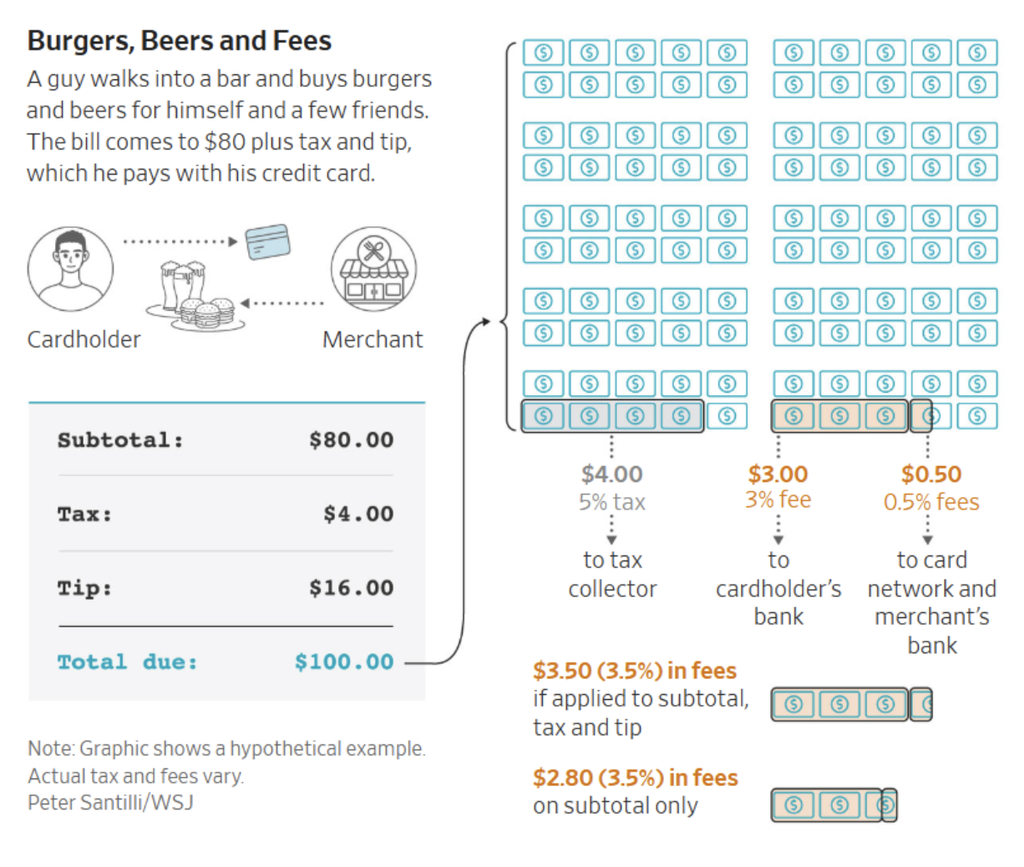
Source: The Wall Street Journal
A DEBATE ON THE DISTRIBUTION OF COSTS
The expansion of loyalty programmes, the increase in card fees and the emergence of new regulatory proposals have reignited the debate over how the payment system operates.
While some analyses, such as the Harvard Business School study mentioned above, focus on the impact that interchange fees may have on merchants and certain groups of consumers, financial institutions emphasise the role these same fees play in maintaining payment infrastructure, security services and access to credit.
Against this backdrop, the discussion centres on how to distribute the costs of a system in which consumers, merchants, financial institutions and payment operators all participate and benefit. At the same time, it raises the broader question of how to strike the right balance between encouraging innovation in payment methods while ensuring that the payment system remains efficient, inclusive and accessible to all participants.
BIBLIOGRAPHY