
The digitization of payments has advanced rapidly over the past decade, driven by technological innovation, operational efficiency, and changes in consumer habits. However, this process has also generated a growing dependence on complex, highly interconnected digital infrastructures that, in many cases, are concentrated in a small number of operators.
At the same time, the international context has become more uncertain. Geopolitical tensions, cyberattacks, technological failures, and recent episodes such as power outages have shown that digital systems, while efficient, are not infallible.
It is precisely in this context that cash once again gains prominence, not as an alternative to progress, but as a pillar of stability.
Sweden: a warning from one of the most digitalized countries
The case of Sweden is particularly telling. Considered one of the most advanced countries in the transition towards a digitalized payment society, its central bank, the Riksbank, recently issued a clear recommendation to citizens. The institution suggests keeping on hand at least 1,000 Swedish kronor (around 90 euros) per adult, an amount intended to cover basic needs for approximately one week.
The Riksbank explicitly acknowledges that a high degree of digitalization can become a source of vulnerability in the event of disruptions. For this reason, it stresses the importance of having alternatives that function even in cases of technological failure or international crisis.
Furthermore, the institution highlights a key point: the cash system can only remain operational if it is used regularly. In other words, relegating cash to use as an emergency resource is insufficient; it must be integrated into everyday life to ensure its future availability.
Cyprus: preparing for conflict scenarios
Following a similar logic of prevention, albeit in a different context, Cyprus has recently called on its population to prepare for potential emergency situations arising from geopolitical tensions.
The Ministry of the Interior has recommended that citizens prepare an emergency kit with basic items to cope with an evacuation or a critical situation during the first hours or days. Among these items, alongside water, food, medicine, and communication devices, cash is explicitly included.
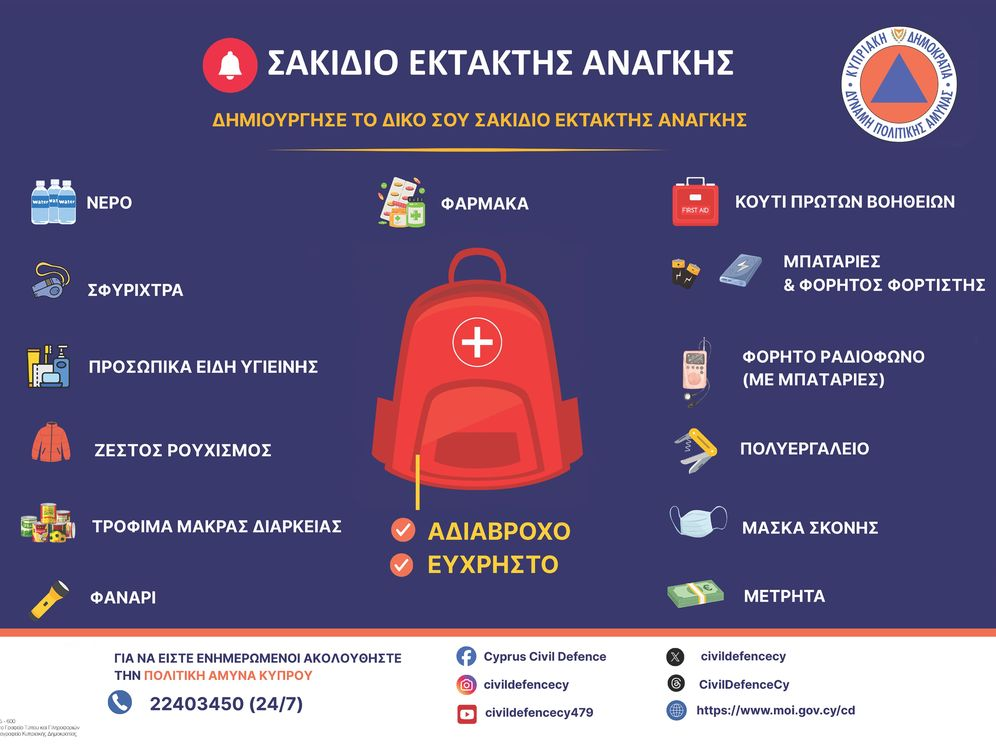
Source: El Confidencial
The inclusion of cash in such recommendations is not coincidental. In crisis scenarios—particularly those involving displacement, power outages, or communication failures—digital systems may cease to operate. By contrast, cash retains its immediate usability without relying on external infrastructure.
This approach reflects a broader conception of civil preparedness, in which physical money is integrated as an essential resource, on the same level as other basic goods.
The ECB: empirical evidence of the role of cash
At the European level, the European Central Bank has reinforced this perspective from an analytical standpoint. In its report “Keep calm and carry cash: lessons on the unique role of physical currency across four crises”, the ECB examines the behavior of cash across several recent events.
The analysis includes the COVID-19 pandemic, the invasion of Ukraine, the power outage in the Iberian Peninsula, and the sovereign debt crisis in Greece. Despite the diversity of these events, the result is consistent across all cases: demand for cash increased significantly.
The ECB identifies a clear pattern: when stability is threatened, citizens turn to cash as a tool of security. In fact, the institution describes cash as a form of “social insurance”, a liquidity backstop that allows economic activity to continue even under adverse conditions.
Cash as critical infrastructure
The examples of Sweden and Cyprus, as well as the ECB’s analysis, converge on a single idea: cash should not be understood solely as a means of payment, but rather as critical infrastructure and as an essential service.
Unlike digital systems, cash has unique characteristics that reinforce its role in emergency situations: it functions without electricity, it does not require an internet connection, it does not depend on intermediaries, and it is universally accessible. In this sense, cash acts as a backup mechanism that provides stability to the payment system as a whole.
Conclusions
In an increasingly digital world, the key question is not how to replace the physical with the technological, but how to build systems capable of withstanding disruptions. Innovation should not be measured solely in terms of efficiency, but also in terms of resilience. In this regard, it is particularly significant that a country such as Sweden, a global reference in payment digitalization, is now recommending that its citizens keep cash at home: a shift that sets an important precedent in Europe.
Cash, far from being a relic of the past, fulfills a quiet yet essential function: ensuring that everyday life can continue even in times of uncertainty. For this reason, more than a means of payment, cash acts as a form of collective security. Its importance is not always visible, but it becomes evident precisely when it is most needed. In this sense, preserving its use and accessibility is not a matter of nostalgia, but of preparedness.
Bibliography
El Confidencial. (March 4, 2026). Cyprus asks its citizens to prepare an emergency kit due to the war: what it should include.
https://www.elconfidencial.com/mundo/2026-03-04/1qrt-chipre-ciudadanos-mochila-emergencia-guerra-tiene-llevar_4314126/
Folguera Agra, R. (March 9, 2026). Sweden asks its citizens to keep 1,000 kronor in cash at home due to the risk of digital collapse. Libre Mercado
https://www.libertaddigital.com/libremercado/2026-03-09/suecia-pide-a-sus-ciudadanos-guardar-en-casa-1-000-coronas-en-efectivo-ante-el-riesgo-de-colapso-digital-7371439/López Esplá, V. (March 9, 2026). The European Central Bank explains why it is important to keep cash at home. ABC
https://www.abc.es/economia/cuentas-corrientes/banco-central-europea-explica-importante-guardes-dinero-20260309042936-nt.html