
| On 23 July 2026, the European Central Bank unveiled ten shortlisted designs for the third series of euro banknotes and opened a public survey that will run until 21 September. The redesign itself is not new — it has been underway since 2022 — but the message the ECB chose to attach to it is. In a moment when cashless payments continue to expand and public confusion about the digital euro persists, the ECB’s own banknotes director framed the project in terms that went well beyond aesthetics: a direct rebuttal of the idea that cash is on its way out. |
A four-year project reaches its most public phase
The ECB launched its search for a new banknote design in 2021, and opened it to public design competition in July 2025, when an EU-wide call for graphic designers drew 1,241 applications. Twenty-five designers were selected to develop full proposals; by July 2026 a jury of 21 experts — nominated by each euro area national central bank, drawn from graphic design, communication, neuroscience and history — had narrowed the field to ten finalist designs, built around two themes chosen by the Governing Council: European culture and rivers and birds.
The culture theme places historical figures on the front of the notes: Maria Callas on the €5, Ludwig van Beethoven on the €10, Marie Curie on the €20, Miguel de Cervantes on the €50, Leonardo da Vinci on the €100, and the Austrian pacifist Bertha von Suttner on the €200. The nature theme depicts European rivers alongside bird species such as the kingfisher and the white stork. Both mark a deliberate break from the current Europa series, whose bridges, windows and doorways are explicitly generic — they depict architectural styles from no real, identifiable place.
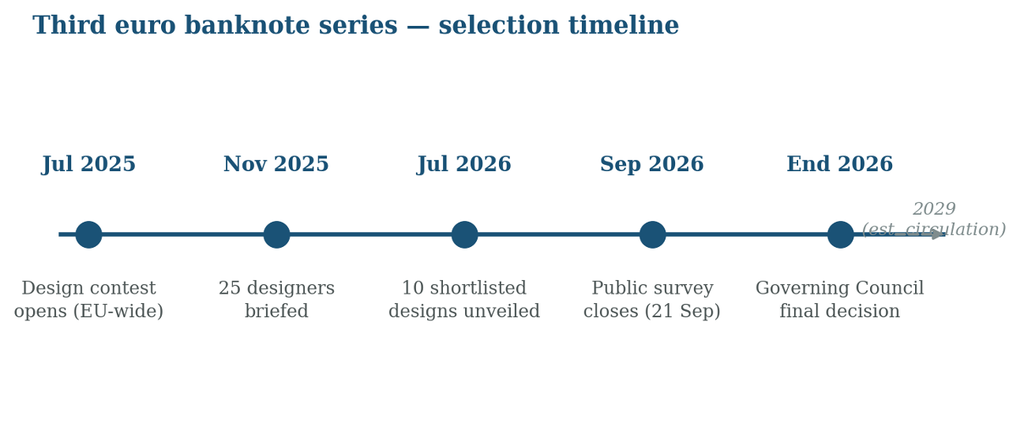
Source: European Central Bank press releases, 23 July 2026 and Design Contest Jury report.
The public survey opened the same day and will remain open until 23:59 CET on 21 September 2026. A parallel survey, using identical questions, is being run by an independent research company among a representative sample of euro area citizens, so that self-selected online respondents can be weighed against a statistically representative panel. ECB President Christine Lagarde described the redesign as an attempt to make the currency “one of the most tangible expressions of Europe” — an unusually explicit statement of the idea that a banknote carries meaning beyond its function as a means of payment. The Governing Council is expected to take its final decision around the end of 2026, with the note in Denaria Europe’s own network circulation not expected before 2029.
The line that matters more than the artwork
For the cash policy community, the significant content of this announcement is not which bird or composer wins. It is a single sentence spoken by Doris Schneeberger, the ECB’s director for banknotes, to Euronews: “No one would renovate a house that is planned to be torn down in the near future.”
It is difficult to construct a more direct institutional signal. A central bank does not commission an EU-wide design contest, brief 25 professional designers, convene a 21-member expert jury and run two parallel public surveys for a product it expects to become obsolete. The ECB is aware that this logic is precisely the point, and Schneeberger made the connection explicit: the redesign exercise is presented, in part, as evidence against the belief — which the ECB itself says it wants to counter — that cash is being phased out in favour of the digital euro.
The institutional language reinforces the same message. Schneeberger described cash and the prospective digital euro as two forms of “public money” — money issued directly by a central bank, as distinct from the commercial bank deposits that carry out most everyday digital payments today. “We are committed to ensuring that paying with public money is always an option, be it with cash or with a digital euro,” she said. “A digital euro would complement cash and not replace it.” This is consistent with the ECB’s position throughout the legal tender regulation process, but it is rare for the point to be made through a banknote design exercise rather than a policy document.
Reading the signal against the data
This communication choice lands at a specific moment. The ECB’s own August 2026 survey of companies found that cash acceptance in the euro area has stopped falling — 92% of firms with physical points of sale now accept cash, up from 90% in 2024 — while mobile payment acceptance has nearly doubled. Denaria Europe’s own Cash Observatory indicators, published earlier this summer, identified the same underlying tension from a different angle: consumer appreciation of cash remains high across the euro area, even as merchant-side infrastructure — bank branches, deposit and withdrawal channels — continues to thin in several countries.
A banknote redesign does not, by itself, change any of those structural conditions. It does not add a single ATM, reopen a single closed branch, or resolve the trilogue negotiations on the legal tender regulation’s access and acceptance provisions. What it does is signal, from the institution that issues the currency, that the redesign is being undertaken on the assumption of continuity — that euro banknotes are expected to remain in active circulation for decades, not years. For an organisation whose daily work involves arguing that cash needs continued legislative and infrastructural protection, having the currency’s own issuer make that same argument through a four-year, EU-wide design process is a useful data point, even if the mechanism through which it makes the argument is symbolic rather than regulatory.
The redesign campaign also gives Denaria Europe a concrete, low-friction opportunity for public engagement: the survey remains open until 21 September, inviting citizens across the euro area to participate directly in a process about the future of cash. Whatever the outcome for the bird or the composer, the invitation itself — millions of Europeans, in Schneeberger’s words, already having taken part — is evidence of an active civic interest in the physical form of money that the cashless-payments narrative tends to obscure.
Sources
1. Euronews, ‘ECB unveils new banknote designs with a defiant message: Don’t count cash out yet’, 19 August 2026. Interview with Doris Schneeberger, ECB Director General Banknotes.
2. European Central Bank, press release, ‘ECB reveals shortlisted designs for new banknotes and launches public survey’, 23 July 2026.
3. European Central Bank, ‘Report of the Design Contest Jury on the winning design proposals for future euro banknotes’, July 2026. Design contest timeline: 1,241 applications, 25 designers selected, 21-member jury.
4. Brussels Signal, ‘ECB puts new euro banknote designs to a public vote’, 24 July 2026. Confirms named figures per denomination and theme details.
5. Il Sole 24 Ore, ‘Six million people have already voted on the new banknotes’, 29 July 2026. Survey deadline 21 September 2026.
6. European Central Bank, ‘Use of cash by companies in the euro area in 2026’, 13 August 2026. Cash acceptance data: 92% (2026) vs 90% (2024).
7. Denaria Europe Cash Observatory, Q1 2025 edition, CHIE/CAT/MERI indicators (referenced for context).