
| World Savings Day, established on 31 October 1924 at the first International Thrift Congress in Milan, is usually framed around what households do with the money they put aside. Saving, however, starts earlier, at the moment of spending, and the instrument used to pay shapes how much is spent. This note brings together the behavioural and central bank evidence on how cash affects spending decisions and budget control, what it costs to pay with it, and why these questions gain weight as deferred-payment products enter the regulated consumer credit market in November 2026. |
Paying hurts, and that helps
Behavioural economics has a name for the discomfort people feel when money leaves their hands: the pain of paying. Prelec and Loewenstein (1998) formalised the idea that consumption and payment are mentally linked, so that the felt cost of a purchase depends on how visibly and how immediately it is paid. Cash couples the two as tightly as possible. The note leaves the wallet at the moment of purchase and its absence can be seen afterwards.
The experimental evidence on the size of the effect is consistent. In Prelec and Simester’s (2001) sealed-bid auctions with real payment, including one for tickets to a Boston Celtics game, participants told they would pay by credit card bid substantially more than those told they would pay in cash; the authors report that willingness to pay rose by up to 100% and that the effect is unlikely to be explained by liquidity constraints alone. The effect is not confined to credit. Runnemark, Hedman and Xiao (2015), in an incentivised experiment, found that willingness to pay was higher with debit cards than with cash, a result robust to cash-on-hand constraints and price familiarity. Neuroimaging has added a mechanism: Banker, Dunfield, Huang and Prelec (2021) observed in an fMRI shopping task that card purchases were associated with strong activation of the striatum, part of the brain’s reward network, independently of the price of the item, whereas cash purchases produced weaker activation and only for cheaper items. The authors note that such reward mechanisms could be exploited by new payment methods.
The effect matters most for those least able to afford overspending. Rick, Cryder and Loewenstein (2008) showed that people differ sharply in how much pain of paying they feel. Those they call spendthrifts feel too little of it and typically spend more than they would ideally like, and the authors find that differences in spending between groups are greatest in situations that amplify the pain of paying. It follows that the friction introduced by cash is most useful precisely for those who find it hardest to hold spending back.
Table 1. Selected evidence on payment instruments and spending
| Study | Design | Finding |
| Prelec & Simester (2001), Marketing Letters | Sealed-bid auctions with real payment | Willingness to pay up to 100% higher when paying by credit card |
| Runnemark, Hedman & Xiao (2015), Electronic Commerce Research and Applications | Incentivised willingness-to-pay experiment | Higher willingness to pay with debit card than with cash |
| Banker, Dunfield, Huang & Prelec (2021), Scientific Reports | fMRI shopping task with real purchases | Card purchases activate reward circuitry regardless of price |
| von Kalckreuth, Schmidt & Stix (2014), Journal of Money, Credit and Banking | German consumer survey data | Consumers who need to monitor liquidity use more cash and switch to cards only at higher amounts |
A budget you can see
The second channel is informational. Von Kalckreuth, Schmidt and Stix (2014), using German consumer survey data, showed that a glance into one’s wallet gives a signal of the remaining budget and of past expenses, and that consumers who need to keep control of their liquidity make a larger share of their payments in cash, hold fewer non-cash instruments and move to cards only for larger amounts. Their model explains why cash use has declined only slowly in some countries despite the wide availability of cards. Hernández, Jonker and Kosse (2017), with Dutch household data, found that consumers on average rate cash and debit cards as equally helpful for monitoring their finances, but that low earners and liquidity-constrained households clearly prefer cash as a budgeting tool, and that this preference shows up in aggregate payment behaviour.
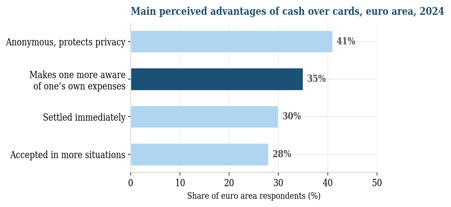
Europeans say as much themselves. In the ECB’s 2024 survey of payment attitudes in the euro area (SPACE), 35% of respondents named greater awareness of their own expenses as one of the main advantages of cash over cards, second only to privacy. The same survey found that cash was used for 68% of payments of €5 or less, the everyday small purchases in which spending most easily slips out of sight.
Chart 1. Respondents could choose up to three advantages
Source: ECB, Study on the payment attitudes of consumers in the euro area (SPACE) 2024.
What it costs to pay
For the consumer, a cash payment carries no transaction fee. Withdrawal is also free for most Europeans: in SPACE 2024, 57% of euro area consumers said they had never paid a fee when withdrawing cash from an ATM, while 11% paid one always or most of the time. For merchants, the Deutsche Bundesbank’s November 2025 study of payment costs in German retail found cash to be the least expensive option per transaction, at an average of €0.43, with the domestic girocard the cheapest in relation to turnover, at just under 1%, and international debit and credit cards more expensive on both measures. The study also found that small retailers pay considerably more than large ones, especially for cashless payments. These results are in line with the ECB’s earlier cross-country study (Schmiedel, Kostova and Ruttenberg, 2012), which found that cash had on average the lowest cost per transaction, closely followed by debit cards, although not in every country.
Merchants’ payment costs tend, over time, to be reflected in the prices all customers pay, including those who pay in cash. A payment mix that shifts towards more expensive instruments therefore weighs on everyone’s cost of living, and relatively more on those who spend a larger share of their income on small everyday purchases.
Credit that does not feel like credit
The spending channel acquires new relevance with the spread of instruments that separate purchase and payment even further. Buy-now-pay-later arrangements allow goods to be taken immediately and paid for in instalments, often interest-free and within the checkout of an app. From 20 November 2026 the revised Consumer Credit Directive, Directive (EU) 2023/2225, brings most of these arrangements, together with small loans below €200, within the scope of EU consumer credit law for the first time, with creditworthiness assessments and pre-contractual information requirements. The legislator’s recognition that deferred payment can lead to over-indebtedness is, in effect, a recognition of the behavioural mechanism described above. At the opposite end of the spectrum sits the only payment instrument that cannot be spent before it is held.
Saving begins at the till
Digital instruments have real advantages in convenience and for larger or remote purchases, and nothing in this evidence suggests paying for everything in cash. What it shows is that cash is a low-cost, self-imposed commitment device that many people use deliberately to keep spending within their means, and that works best for exactly the households with the least margin for error. For that device to remain available, cash must remain easy to obtain and accepted where people shop. On World Savings Day, that practical condition deserves a place alongside the more familiar messages about putting money aside.
| References 1. Prelec, D. and Loewenstein, G. (1998), ‘The red and the black: Mental accounting of savings and debt’, Marketing Science, 17(1), 4–28. 2. Prelec, D. and Simester, D. (2001), ‘Always leave home without it: A further investigation of the credit-card effect on willingness to pay’, Marketing Letters, 12(1), 5–12. 3. Runnemark, E., Hedman, J. and Xiao, X. (2015), ‘Do consumers pay more using debit cards than cash?’, Electronic Commerce Research and Applications, 14(5), 285–291. 4. Banker, S., Dunfield, D., Huang, A. and Prelec, D. (2021), ‘Neural mechanisms of credit card spending’, Scientific Reports, 11, 4070. 5. Rick, S. I., Cryder, C. E. and Loewenstein, G. (2008), ‘Tightwads and spendthrifts’, Journal of Consumer Research, 34(6), 767–782. 6. von Kalckreuth, U., Schmidt, T. and Stix, H. (2014), ‘Using cash to monitor liquidity: Implications for payments, currency demand, and withdrawal behavior’, Journal of Money, Credit and Banking, 46(8), 1753–1786. 7. Hernández, L., Jonker, N. and Kosse, A. (2017), ‘Cash versus debit card: The role of budget control’, Journal of Consumer Affairs, 51(1), 91–112. 8. European Central Bank (2024), Study on the payment attitudes of consumers in the euro area (SPACE) 2024, December 2024. 9. Deutsche Bundesbank (2025), ‘Cash and girocard payments least expensive option for retailers’, press release on the study The cost of payment methods in the retail sector, November 2025. 10. Schmiedel, H., Kostova, G. and Ruttenberg, W. (2012), ‘The social and private costs of retail payment instruments: a European perspective’, ECB Occasional Paper No 137. 11. Directive (EU) 2023/2225 of 18 October 2023 on credit agreements for consumers, applicable from 20 November 2026. |